


Permanent Magnetic Drum
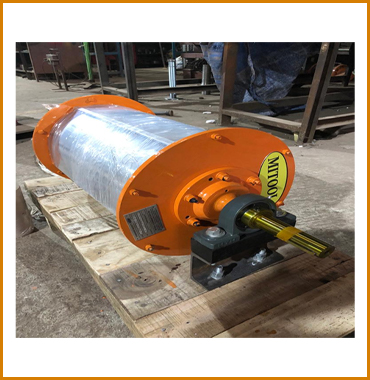

The permanent magnetic drum is the working core of every drum-type magnetic separation unit. Mitool Equipments manufactures the magnetic drum as a stand-alone component — supplied bare, mounted on pedestals, with a V-groove pulley for V-belt or link-belt drive — so customers who already have a feed system, housing, and discharge chute can simply integrate the drum into their existing process. This is the most economical way to add magnetic separation to a sponge iron line, foundry sand recovery circuit, mineral processing stream, or recycling plant.
Inside a non-magnetic stainless-steel rotating shell, a fixed permanent magnet assembly creates a powerful field that covers approximately half the drum's circumference. Material fed across the top of the drum is sorted continuously: non-magnetic content falls clear under gravity, while ferrous particles cling to the shell, travel around with it, and only release once they have moved past the magnetic zone. The magnet itself is stationary — only the shell rotates.
• Construction :
- Stationary magnet assembly : ferrite or NdFeB magnets arranged for uniform field across the drum width, covering ~180° of circumference
- Rotating shell : non-magnetic stainless steel SS-304 (SS-316 on request), suitable for wet or dry service
- Shaft : high-tensile carbon steel, sized for combined torque, radial belt-drive load, and magnetic attraction
- Bearings : heavy-duty roller bearings in sealed plummer block housings
- Drive provision : V-groove pulley fitted as standard — customer adds motor and V-belt drive
- Pedestals : fabricated bases for floor or framework mounting
• Magnetic drum specifications :
| Parameter | Range |
|---|---|
| Drum Diameter | 300 / 400 / 500 / 650 / 800 / 1000 / 1200 / 1500 mm |
| Drum Width (Face) | 300 mm - 2000 mm (Custom widths possible) |
| Magnet Type | Ferrite Ceramic / NdFeB Rare Earth |
| Field Strength (Ferrite) | 1500 - 2500 Gauss at Shell Surface |
| Field Strength (NdFeB) | 4000 - 5000 Gauss at Shell Surface |
| Magnet Coverage | Approximately 180° of Drum Circumference |
| Shell Material | Stainless Steel SS-304 (SS-316 Optional) |
| Shaft Material | EN-8 / EN-9 Carbon Steel |
| Drive Provision | V-Groove Pulley for V-Belt or Link-Belt |
| Service | Wet / Dry / Hot (Within Magnet Temperature Limits) |
• Where the magnetic drum is used
A bare permanent magnetic drum is typically installed at the discharge end of chutes, spouts, screw conveyors, bucket elevators, vibratory feeders, or any other carrying medium — wherever material is already being moved and a magnetic capture point is needed. Mitool customers use drums in :
- Sponge iron plants : removing ferrous from kiln discharge, sizing screens, magnetite recovery
- Foundry sand reclamation : recovering tramp iron from used moulding sand before reuse
- Mineral processing : wet drum separation in iron ore beneficiation
- Cement & lime : tramp removal from raw material conveying
- Recycling : ferrous recovery from MSW, glass cullet, plastic recyclate
- Power plants : tramp removal from coal handling lines
- Chemicals, food, pharma : in-line ferrous removal from intermediate process streams
• Why choose a bare drum from Mitool
- Lowest total system cost : when an existing process already has feed and discharge infrastructure, only the drum is needed
- Easy integration : V-groove pulley drive lets the customer use any standard motor and V-belt configuration
- Robust shell : SS-304 standard, with optional wear-resistant lining for highly abrasive material
- Custom sizing : drums made-to-order in any practical diameter and width combination
- Long-life magnets : everlasting magnetic strength for the design life of the installation
Frequently Asked Questions
A. A magnetic drum is the bare drum assembly only — magnet, shell, shaft, bearings, and a V-groove pulley for drive. A magnetic drum separator is the complete unit — drum plus housing, feed hopper, jig shaker tray, motorised drive, and discharge chutes. Customers choose the drum when they already have feed and discharge infrastructure; they choose the full separator for plug-and-play installation.
A. The stationary magnet assembly covers approximately 180° (half the circumference) of the drum. This provides material with a half-rotation of magnetic contact before release, allowing sufficient time to capture and transport ferrous particles effectively.
A. Yes — wet-service drums are available as a standard configuration. The shell, bearings, and sealing arrangement are selected according to the moisture level and corrosiveness of the slurry. Wet or dry service requirements should be specified during enquiry.
A. Ferrite magnets are stable up to approximately 250 °C and generally do not require cooling for normal industrial applications. NdFeB magnets may lose performance above around 80 °C (standard grade). For higher-temperature applications, high-temperature NdFeB grades or ferrite magnets are recommended.
A. A standard 3-phase TEFC induction motor with a geared reducer is commonly used, connected to the drum's V-groove pulley through a V-belt drive. Mitool can recommend the suitable motor size based on drum diameter, width, and operating conditions.
CONTACT US

Plot No. E-25, E-25/1, M.I.D.C. Industrial Area, Additional Ambernath, Anand Nagar, Ambernath (East), Dist. Thane - 421506, Maharashtra, India.
Tel : + 91-251-2621925 / 26 / 27 / 28
Fax : + 91-251-2621927 / 28
Email: 