


Permanent Magnetic Pulley
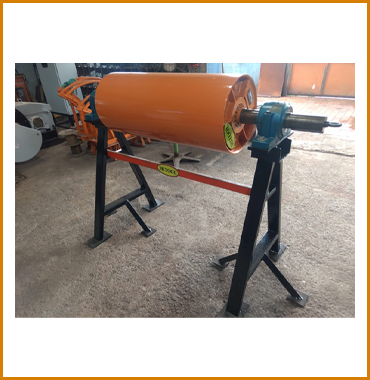

A permanent magnetic pulley replaces the standard head pulley of a belt conveyor. As material reaches the discharge end of the conveyor, non-magnetic material is thrown clear in a normal trajectory, while ferrous tramp metal is held to the belt by the magnetic field — wrapped around the pulley — until the belt curves away beneath the magnet, at which point the iron releases into a separate collection chute. This makes a magnetic pulley one of the most elegant, low-maintenance iron removal solutions in any plant: it adds no extra equipment, replaces a part the conveyor already needs, and works continuously with zero operator intervention.
Mitool Equipments manufactures permanent magnetic pulleys in both ferrite and rare-earth NdFeB configurations, in diameters from 300 mm to 1200 mm, with face widths matched to standard Indian and international belt-conveyor specifications. They are used in mining, sponge iron, cement, recycling, waste management, glass and ceramic plants, and aggregate processing — anywhere a belt conveyor handles material that must be cleared of tramp metal.
• Working principle
The magnet inside the pulley generates a strong field that extends through the belt and into the material above. Non-magnetic material follows the belt's natural discharge trajectory at the head pulley and drops clean. Ferrous particles, however, are pulled down to the belt by the magnetic force, wrap around the pulley with the belt, and only release when the belt pulls away from the pulley — at which point the iron drops vertically into a separate chute, while the cleaned product has already moved forward into the main discharge.
• Construction
- Magnet assembly : block ferrite or NdFeB magnets, fully encased and sealed inside the pulley shell
- Shell : Non-magnetic stainless steel SS-304 (SS-316 optional) with optional lagging — plain rubber, herringbone, or ceramic — for belt grip
- Shaft : Heavy-duty roller bearings in plummer block housings, sealed against dust ingress
- Field uniformity : Magnet layout designed to give uniform field strength across the full belt width
• Magnetic pulley specifications
| Parameter | Range |
|---|---|
| Pulley diameter | 300 / 400 / 500 / 650 / 800 / 1000 / 1200 mm |
| Face width | 300 mm - 2000 mm (matched to belt width) |
| Magnet type | Ferrite (1500-2500 G surface) / NdFeB (3500-4500 G surface) |
| Shell material | Stainless steel SS-304 |
| Shaft material | EN-8 / EN-9 carbon steel |
| Belt grip lagging | Plain rubber / Herringbone rubber / Ceramic (optional) |
| Bearings | Heavy-duty sealed roller bearings in plummer blocks |
| Field uniformity | Across full face width |
| Suitable belt speed | Up to 2.5 m/s (standard); higher on request |
• Applications
- Mining & mineral processing : tramp iron removal from ore on incoming conveyors before crushers
- Sponge iron plants : protection of kilns and downstream screens from oversized tramp
- Cement industry : tramp removal from limestone and clinker conveying lines
- Recycling : ferrous recovery from MSW, e-waste, and construction & demolition waste
- Glass & ceramics : Removal of metal contamination from raw material feed
- Aggregate & sand : tramp removal from crushed stone and washed sand
- Foundry sand reclamation : ferrous recovery from used moulding sand
• Advantages over alternative methods
- Replaces existing head pulley : no additional structure or platform required — the conveyor already has a head pulley, the magnetic version simply does double duty
- Truly continuous operation : captured iron releases automatically as the belt leaves the pulley — no shutdown, no manual cleaning
- Permanent magnets : no power consumption by the magnet, no coils to burn out, no transformer or rectifier needed
- Lower maintenance than overband : no separate cleaning belt, no motor or drive for the magnet itself, only the conveyor's existing pulley bearings to maintain
- Excellent for fine iron : very close magnetic gap (just the belt thickness) means even small particles are captured efficiently
• Choosing between a magnetic pulley and an overband separator
A magnetic pulley is best when iron particles are mostly small, the conveyor is fixed in location, and continuous low-maintenance operation is the priority. An overband magnetic separator is preferred when iron pieces are large or heavy, when high lift is needed (deep material burden), or when the conveyor head end cannot be modified. Mitool engineers can recommend the right combination — and many plants use both: a pulley for the bulk of fine tramp, plus an overband to catch the occasional heavy piece.
Frequently Asked Questions
A. Standard belts up to 12 mm thick (covers plus carcass) work well. The magnetic field weakens slightly through thicker belts, so for belts above 12 mm consider a rare-earth pulley or move to an overband separator if iron is large.
A. Standard belts up to 12 mm thick (covers plus carcass) work well. The magnetic field weakens slightly through thicker belts, so for belts above 12 mm consider a rare-earth pulley or move to an overband separator if iron is large.
A. For free iron in dry material, capture is typically 95-99% of magnetic content when properly sized. Fine iron in deep material beds is harder — the larger the burden depth, the lower the capture, so sizing must consider belt loading.
A. No — ferrite and NdFeB magnets retain effectively full strength for the life of the installation. Avoid exposure above 80 °C for standard NdFeB, and avoid mechanical impact, and the magnet will outlast the pulley shell.
A. this is one of the most common Mitool applications. The original pulley is removed and the magnetic pulley installed in its place. Lagging type and field strength are matched to the application.

